ECOLOGICAL CENTER
in the Jungle
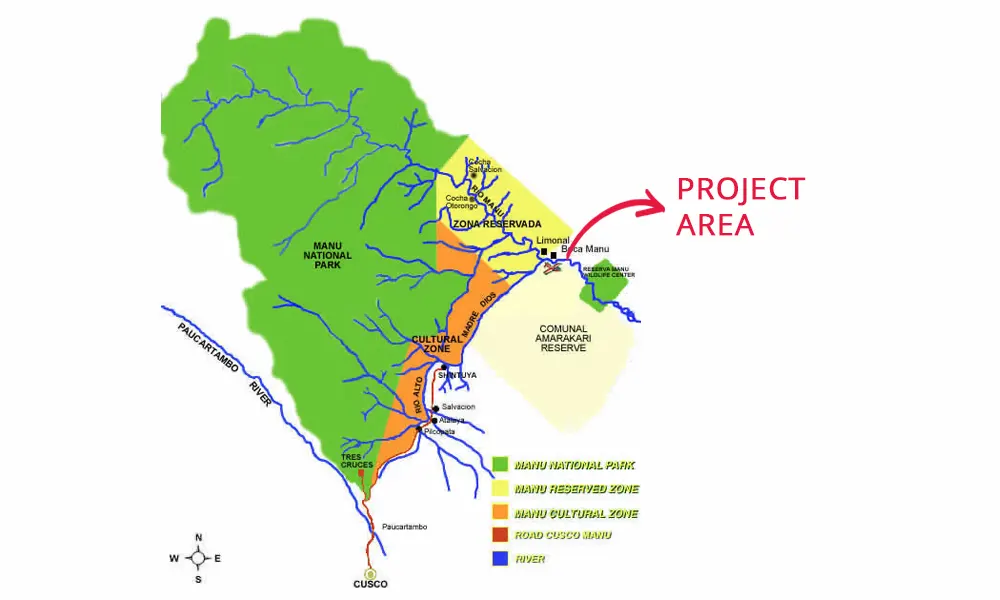
We have 20 hectares of land in the rainforest area of the Fitzcarrald District, Manu Province, and Madre de Dios Department. (Very close to Manu National Park and Amarakaeri Communal Reserve), the project’s development combines four core concerns: the protection of nature and the environment, support for Indigenous culture, the promotion of youth, and the long-term independence of the project. “An analysis of successful projects in the region shows that the most effective approaches are based on the direct participation of the local Indigenous population from the outset”.

Threats and conflict lines: a fragile paradise under pressure
Despite its protected status, the Manu Biosphere Reserve, especially its buffer zones, faces massive threats driven by external economic interests.
Illegal gold mining
Especially in the Madre de Dios region, informal gold mining leads to large-scale deforestation and the poisoning of rivers and food chains with mercury, with devastating consequences for health and the environment.

Illegal logging and agriculture
The expansion of the agricultural frontier by settlers, often for cattle ranching, as well as illegal logging, destroy valuable forest areas. Particularly alarming is the increase in coca cultivation in buffer zones, driven by drug cartels, leading to land grabbing, violence, and intimidation of local communities.

Infrastructure projects
The construction of roads, such as the one now running along the national park border, not only fragments animal habitats but also opens the door for loggers, miners, and illegal settlers who can reach previously inaccessible areas.

Human-wildlife conflicts
As human settlements and agricultural lands increasingly approach protected areas, conflicts also increase, for example, when predators such as pumas or spectacled bears attack farm animals, often leading to retaliatory killings.

Legal uncertainty
A fundamental problem is that the property titles of many Indigenous communities often include only agricultural lands, but not the forests, rivers, and hunting areas that make up their integral and ancestral territory. This legal loophole weakens their ability to defend themselves against intrusion by outside agents, as the State, not the Community, is considered the injured party in the event of illegal forest clearance.

Integration of the association’s objectives
Nature conservation
The project directly contributes to reforestation and promotes biodiversity-friendly agriculture, serving as an alternative to slash-and-burn agriculture.

Cultural preservation
The project’s central concern is the preservation, validation, and transmission of traditional knowledge, which strengthens cultural identity.

Youth development
Young people receive training in sustainable agriculture, product processing, quality management, and entrepreneurial skills, opening up new avenues for them in the so-called “BioTrade” sector.

Research, education
Focuses on scientific research on biodiversity and knowledge transfer. In terms of education, we offer volunteer programs and specialized educational trips.

Project Area